China’s sofa bed manufacturers serve buyers seeking compact seating, guest beds, and flexible layouts. The right supplier can make a small apartment feel more useful, not merely more furnished. Yet a polished catalogue tells only part of the story. Frame construction, mattress thickness, upholstery samples, and opening mechanisms deserve close review. Small details matter. Charles Eames’s well-known design principle captures this well: “The details are not the details. They make the design.” For a sofa bed, that means checking how smoothly the seat converts and whether the sleeping surface feels even.
This guide introduces leading Chinese sofa bed manufacturers and suppliers for global buyers. It considers product range, customization, production capability, communication, and quality checks. Buyers can compare compact click-clack models with pull-out designs, then ask suppliers for dimensions, material specifications, and clear product photographs. The keyword “Sofa Bed Sofa Bed” may look repetitive, but it reflects the search language some buyers use when exploring this category. A sample order can reveal issues that brochures miss. Fabric color may shift under showroom lighting, and a mechanism that works once may feel different after repeated use. That is worth admitting. Supplier selection is not a neat checklist; it involves trade-offs between price, comfort, lead time, and finish. With careful questions and direct verification, buyers can build a shortlist suited to their market and customers.
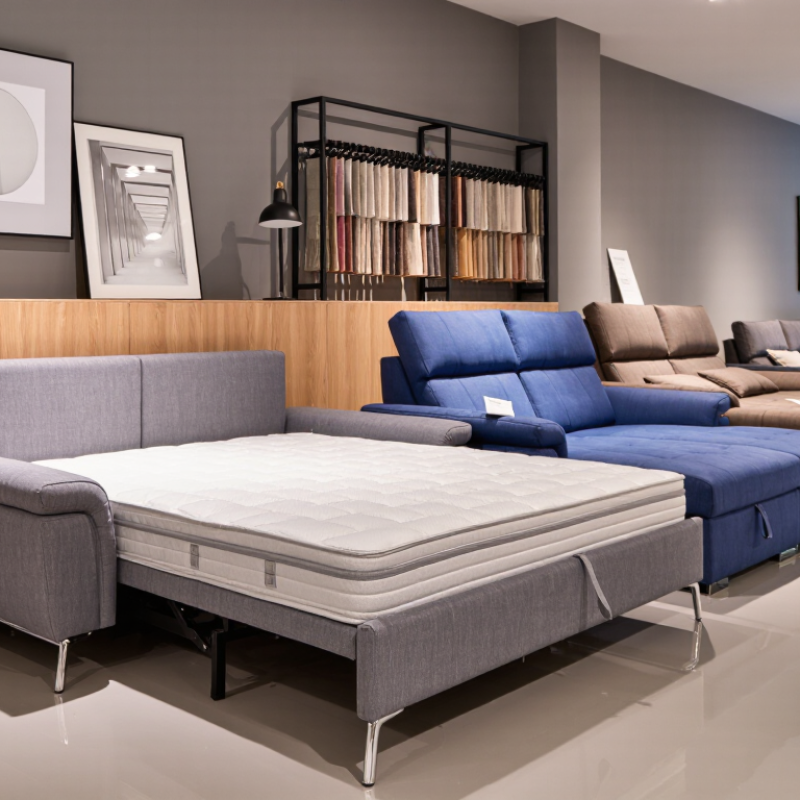
A sofa bed combines seating with a sleeping surface, usually by folding down the back or pulling a mattress from its frame. By day, it can anchor a living room; at night, it gives guests a place to sleep without a dedicated spare bed. It suits small apartments, studios, home offices, and guest rooms. Some designs work for occasional stays, while others are built for more regular use. The difference matters.
Grand View Research estimated the global home furniture market at $231.26 billion in 2023 and forecast a 5.0% compound annual growth rate from 2024 to 2030. This broad market figure is not specific to sofa beds, but it reflects continuing demand for home furnishings. A sofa bed is not automatically a comfortable daily bed. Check the mattress support, opening mechanism, and full extended dimensions. A common planning miss: measuring only the closed sofa. Measure the floor space it needs when opened, too.
Tips: Test the conversion mechanism and sit or lie on the mattress, if possible. Check whether nearby tables, rugs, or doorways block its movement. Allow room to walk around it. A little extra measuring helps.
Designing a sofa bed in China starts with the frame, not the fabric. Engineers check seat depth, backrest angle, mattress thickness, and the room needed for opening. A steel mechanism may suit frequent conversion, while a timber frame can reduce weight. Prototypes are opened and closed repeatedly. Small faults show up fast.
Materials are then matched to the design. Teams inspect foam density, upholstery seams, hinges, and moving clearances before production. They cut fabric with digital patterns, assemble the frame, fit the mechanism, and test the finished unit for stability and operation. The details matter. A few millimeters can cause fabric to snag or a seat to feel uneven.
China’s role as a major furniture manufacturing base gives suppliers access to established material and component networks. Grand View Research estimated the global furniture market at USD 736.75 billion in 2023, showing the scale of demand manufacturers serve. That figure covers furniture broadly, not sofa beds alone. Buyers should therefore ask for product-specific test records, material specifications, and inspection criteria. A factory sample can look convincing, yet still reveal weaknesses after repeated use. No process catches everything.
China’s sofa bed manufacturers and suppliers operate across several connected furniture-production regions. Guangdong, especially Foshan and Dongguan, has dense upholstery, frame-making, and export-service networks. Zhejiang and Jiangsu also host furniture producers and component suppliers. For buyers, this means a sofa bed’s frame, mechanism, foam, and upholstery may come from different locations, even when final assembly happens in one factory.
The National Bureau of Statistics of China reported that above-designated-size furniture manufacturers generated 655.7 billion yuan in operating revenue in 2023. That figure describes the wider furniture industry, not sofa beds alone, but it shows the scale of China’s production base. The China National Furniture Association also tracks regional furniture clusters, including major coastal manufacturing areas. In practical sourcing, proximity to ports can help with export logistics, while inland suppliers may offer different cost structures. The map is not perfectly tidy.
Buyers should verify where each production step takes place. Ask for the factory address, mechanism origin, upholstery specifications, and sample lead time. A factory visit can reveal details that a product sheet misses, such as stitching consistency or how smoothly the bed frame opens. Distance matters. A component sourced from another province can add coordination time, and suppliers do not always explain that early. Check the details before comparing quotations.
Global buyers usually encounter three types of sofa bed suppliers: direct manufacturers, OEM or ODM producers, and trading or export companies.
Direct manufacturers make frames, mechanisms, and upholstery in their own facilities. Buyers can discuss dimensions, fabric rub ratings, mattress thickness, and carton protection with the production team. Factory access helps, but it does not guarantee consistent quality. Request a finished sample and written specifications before placing a large order.
OEM and ODM suppliers suit buyers who need custom designs or private-label production. They may adjust arm shapes, fabrics, or opening mechanisms to match a market brief. Ask which parts are made in-house and which come from subcontractors. Small details matter. A mechanism that feels smooth in a showroom may behave differently after repeated opening.
Trading and export companies, meanwhile, coordinate orders across several factories and can assist with documentation, consolidation, and shipping. This can simplify sourcing, though an extra intermediary may slow technical answers. Compare lead times, inspection arrangements, spare-part availability, and packaging details in writing.
No supplier type fits every project; even a clear brief can overlook how a sofa bed will be used each day.
Global buyers should assess a sofa bed as both seating and a sleeping surface. Ask suppliers for a current specification sheet covering frame materials, mattress dimensions, fabric composition, and mechanism type. Then compare it with a physical sample. Check that the bed opens smoothly, locks securely, and sits level on the floor. Small details matter. A loose hinge or uneven seam can become a costly complaint after delivery.
Quality checks should match the intended market and use. Request relevant test reports, inspection records, and clear criteria for acceptable defects. A report is useful, but it does not replace checking production goods. Measure the folded and extended units, inspect stitching around stress points, and confirm that the mattress returns to shape after use. A showroom sample can flatter. It may not represent every production run, so buyers should agree on pre-shipment inspection steps in writing.
Export readiness is more than offering an attractive price. Confirm carton dimensions, gross weight, loading plans, labeling needs, and lead times before placing an order. Ask how the supplier handles damaged packaging or missing parts. Response quality is evidence, too: precise answers and consistent records make coordination easier. Still, no checklist removes all risk. Buyers should leave room for rechecking assumptions, especially when specifications change late.
Buyers commonly work with direct manufacturers, custom-design producers, or trading and export companies. Each offers different levels of production access and coordination.
Ask about frame materials, mattress thickness, fabric durability, and carton protection. Request a finished sample and written specifications. Factory access is helpful, not a guarantee.
These suppliers can adjust arm shapes, fabrics, and opening mechanisms. Ask which components are made in-house and which are subcontracted. Small parts matter.
It may coordinate orders across factories, documentation, shipment consolidation, and shipping. Technical answers can take longer when another party is involved.
Open and close it several times. Check that the mechanism moves smoothly, locks securely, and sits level. Look closely at hinges and seams.
Review frame materials, mattress dimensions, fabric composition, and mechanism type. Compare the specification sheet with a physical sample. A showroom sample can flatter.
No. Request relevant reports and inspection records, then agree on pre-shipment checks. Measure units and inspect stitching around stress points. Reports have limits.
Confirm carton dimensions, gross weight, loading plans, labeling needs, and lead times. Ask how missing parts or damaged packaging are handled. I may be missing a detail. Recheck changed specifications in writing.
A sofa bed combines everyday seating with a sleeping surface, making it useful for compact homes, guest rooms, hotels, and flexible living spaces. Its design balances comfort, ease of conversion, durability, and efficient use of space. In China, manufacturers typically develop sofa beds through product planning, frame construction, upholstery, mechanism fitting, and quality checks. Materials, dimensions, mattress options, and folding systems can be adapted to different customer needs and market preferences.
China’s sofa bed suppliers operate across established furniture-making regions and serve buyers through factories, trading companies, and export-focused suppliers. Global buyers can compare these supplier types by considering production capacity, communication, customization, sample quality, packaging, and experience preparing goods for shipment. A careful assessment of construction, mechanisms, upholstery, inspection procedures, and export readiness helps buyers choose products suited to their requirements. Whether searching for a compact sleeper or a larger convertible design, buyers can use these factors to evaluate the Sofa Bed Sofa Bed market more confidently.

ZoomRoom