Choosing the best Modular Sofa in 2026 starts with the room, not the showroom. Measure the wall, doorways, stair turns, and the path between seats before comparing styles. A configuration that looks spacious online may block a cupboard or crowd a coffee table at home. Fit comes first.
The 2024 U.S. Houzz & Home Study reported a median renovation spend of $24,000 in 2023, up from $22,000 in 2022. That figure covers home renovation projects, not sofa purchases, so it is context rather than proof of furniture demand. Still, it underlines why a substantial home purchase deserves careful planning. A sofa’s total value depends on more than its initial price: consider frame and cushion construction, fabric performance, warranty terms, delivery access, and the cost of replacement modules.
Modular designs can adapt when rooms, households, or routines change. But flexibility is not automatic. Check whether each piece connects securely, whether covers can be cleaned or replaced, and whether the brand sells matching modules over time. If you have pets, children, or a narrow entryway, bring those details into the decision early. Product specifications and showroom impressions help, but neither can predict exactly how a sofa will feel after months of use. This guide weighs practical evidence alongside comfort, because the “best” choice is personal—and sometimes a little less perfect than the pictures suggest.
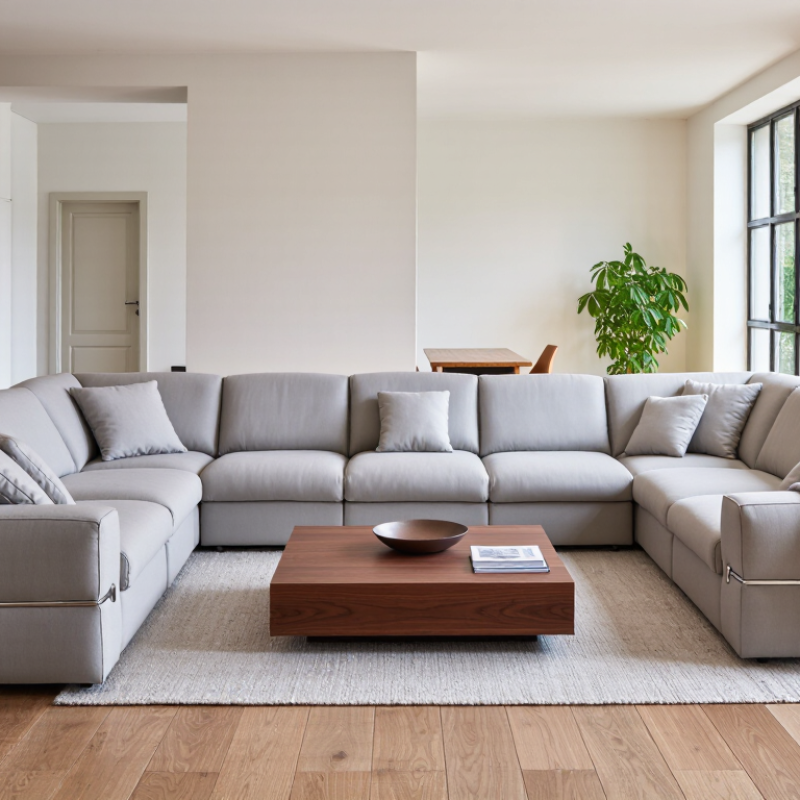
Define Household Needs, Seating Capacity, and a Modular Sofa Budget
Start with your household’s real routine, not a showroom photo. The U.S. Census Bureau’s 2023 American Community Survey puts the average household size at about 2.5 people. That is a midpoint, not a seating rule. Count regular users, overnight guests, and the person who claims the long end for naps. Measure doorways, stair turns, and wall clearance; a sofa that cannot reach the room is no bargain. Sketch daily use: movie nights, children’s toys, or a quiet reading corner. Small details matter.
Set a complete budget before choosing modules. The U.S. Bureau of Labor Statistics’ 2023 Consumer Expenditure data reported about $2,862 in annual household spending on furnishings and equipment. That category covers far more than sofas, so treat it as context, not a recommended sofa allowance. Reserve money for delivery, assembly, fabric protection, and replacement covers. Compare the base price with the cost of connectors and extra seats; add-ons can quietly raise the total. I would keep a small buffer, even if that means starting with fewer pieces. Less seating can feel like a compromise. Sometimes it is the wiser fit.
Measure Room Access and Allow 30–36 Inches for Main Walkways
A modular sofa can look compact online and feel enormous in a real room. Measure the room, then measure every access point: entry doors, hallways, stair turns, and elevator openings. Record the narrowest clear width, not just the door’s listed size. For the sofa, check each module’s width, depth, and height; a single piece may need to pass through a tight turn. Cardboard templates can reveal awkward corners before delivery day.
Plan for 30–36 inches of clear space along main walkways. The U.S. Access Board’s 2010 ADA Standards specify a 36-inch minimum clear width for many accessible routes. That standard applies to covered accessible routes, not every private living room, but it offers a useful planning benchmark. A 30-inch path may work in a smaller home; 36 inches feels easier when people pass or carry laundry. Check the clearance with drawers and doors open, too. A tape measure can miss the way a room actually flows.
Tips: Mark the sofa footprint with painter’s tape, then walk around it with a laundry basket. Leave 30–36 inches on the busiest route, and remeasure after shifting a module. Small adjustment. Worth doing. A floor plan may look tidy while the real path still feels cramped.
How to Choose the Best Modular Sofa in 2026: Main Walkway Clearance
Allow 30–36 inches of clear width for main walkways around your modular sofa. Measure the narrowest access route and account for doors and other obstacles before choosing your layout.
Compare Cushion Support Using 1.8 lb/ft³ Foam as a Common Benchmark
For a modular sofa, 1.8 lb/ft³ is a useful cushion-foam benchmark, not a guarantee of comfort or lifespan. It converts to roughly 28.8 kg/m³. The Polyurethane Foam Association’s technical guidance explains that density measures foam mass per volume; it is not the same as firmness. Two cushions at this density can feel quite different.
Check the test details. ASTM D3574 sets standard methods for measuring flexible foam properties, including indentation force deflection and compression set. Ask whether the quoted density applies to the seat foam itself, rather than a layered cushion’s average. Then press the cushion near its edge and sit for several minutes: it should support your hips without feeling like a hard platform. Small detail, big difference.
One weakness in the 1.8 benchmark: it says little about how a modular cushion performs after repeated use. Cover fabric, foam thickness, spring support, and cushion construction also matter. A technical data sheet is more useful when it names the foam type, density, and test results. If a seller provides only “high-density foam,” ask for numbers. Even then, real comfort is personal, and this benchmark is only a starting point.
How to Choose the Best Modular Sofa in 2026? - Compare Cushion Support Using 1.8 lb/ft³ Foam as a Common Benchmark
Use this guide to compare general cushion and frame specifications, not individual products. Foam density is a durability indicator, not a measure of firmness, and 1.8 lb/ft³ is a common reference point rather than a universal quality standard. Actual performance also depends on foam formulation, construction, use, and care.
| Comparison point |
Entry-level example |
Common benchmark example |
Higher-density example |
What to check before buying |
| Seat foam density |
Below 1.8 lb/ft³ |
Around 1.8 lb/ft³ |
Above 1.8 lb/ft³; some cushions use 2.0 lb/ft³ or higher |
Ask for the seat-foam density specifically. A higher number may support better durability, but it does not by itself prove comfort or quality. |
| Firmness information |
May be described with a comfort label only |
Density disclosed; firmness may be listed separately |
Density and firmness are both specified |
Density describes foam mass per volume. Firmness is a different property; try the cushion or ask for a firmness specification. |
| Cushion construction |
Single foam layer |
Foam core with a fiber or fiber-blend wrap |
Layered foam or a foam core with a specified wrap |
Ask what each layer is made of. A soft wrap can change the initial feel and may need occasional fluffing or repositioning. |
| Seat support underneath |
Support type not clearly stated |
Webbing or sinuous springs, with construction details available |
Clearly documented support system and frame attachment |
Ask about the suspension, spacing, and attachment method. Cushion foam density alone does not describe the full seat-support system. |
| Modular connections |
Modules mainly rest beside one another |
Connectors supplied for keeping modules aligned |
Connectors are specified, accessible, and replaceable |
Check how sections attach, whether connectors are included, and whether the layout can be reconfigured without extra parts. |
| Cushion shape and upkeep |
Loose cushions; maintenance guidance may be limited |
Removable cushions with care instructions |
Replaceable covers or cushion inserts, with care guidance |
Confirm whether covers are removable and washable, and whether replacement inserts are available. Follow the stated cleaning instructions. |
| Best fit for |
Occasional use or a tighter budget, if the construction and warranty are acceptable |
Shoppers seeking a commonly used foam-density reference for regular home use |
Shoppers prioritizing a higher stated seat-foam density, subject to comfort and construction checks |
Match the sofa to your household, preferred feel, room layout, warranty, and maintenance needs. |
Quick comparison rule: Treat 1.8 lb/ft³ as a useful starting benchmark, then compare firmness, cushion layering, seat suspension, modular connectors, cover care, and warranty. Request written specifications when details are missing.
Assess Upholstery Wear Against ACT’s 15,000 Double-Rub Residential Guideline
How to Choose the Best Modular Sofa in 2026?
When comparing modular sofas, check the upholstery’s abrasion result before judging a fabric by touch alone. The Association for Contract Textiles (ACT) lists 15,000 Wyzenbeek double rubs as a residential upholstery guideline. A double rub is one back-and-forth motion against a test surface. It offers a useful baseline, not a promise of years of service.
Ask for the exact test method and result. ASTM International’s ASTM D4157 describes the Wyzenbeek abrasion test, while ACT cautions that results from different abrasion methods are not directly comparable. More rubs do not automatically mean a longer-lasting sofa. Seams, fabric construction, cleaning, pets, and sunlight also affect wear. Check the manufacturer’s care instructions, and inspect sample fabric under your home’s lighting. Small details matter.
Picture a seat cushion used every evening: its center may flatten or show friction before a rarely used corner does. For a modular sofa, ask whether replacement covers or individual cushions are available. That can matter more than an impressive test number. The 15,000 figure is helpful. But it is not the whole story. I would still want to know how the fabric feels after repeated sitting; lab numbers cannot answer every real-life question.
Check Frame Durability and Connectors, Including ANSI/BIFMA X5.4 Test Evidence
When choosing a modular sofa, inspect the frame and the joints that hold each section together. Look for reinforced corners, secure fasteners, and connectors that resist sideways movement. A quick showroom tug can reveal looseness, but it cannot replace documented testing. Small details matter.
Ask for a laboratory report referencing ANSI/BIFMA X5.4, the standard for public and lounge seating. Check the tested model, configuration, connector type, test date, and pass/fail results. A report for one layout may not cover every modular arrangement. Also, the standard’s reference alone does not prove that every connector was tested; ask the seller or manufacturer to clarify the test scope.
EPA’s 2018 materials report estimated that 12.1 million tons of furniture and furnishings were generated in the United States. That figure is not a sofa lifespan measure, but it underlines why durable construction deserves scrutiny.
Examine the underside, if possible. Look for solid support rails, tight screw points, and no visible gaps around connector plates. Ask whether the frame was tested with the actual joined sections, not as separate seats. Request the full report, not just a badge or a brief claim. Read it carefully. Even strong test evidence cannot predict every home’s wear, and that uncertainty is worth acknowledging.
Conclusion
Choosing the best Modular Sofa in 2026 starts with your household’s needs: consider how many people will use it, how the seating will be arranged, and what budget feels practical. Measure the room as well as doorways, hallways, and stairs to confirm each section can be delivered and assembled. Plan for roughly 30–36 inches of clearance along main walkways so the finished layout remains comfortable to move around.
Compare construction details before deciding. Cushion foam density around 1.8 lb/ft³ is a useful point of reference for support, while upholstery can be assessed against ACT’s 15,000 double-rub residential guideline. Also review frame materials, connection hardware, and available durability documentation. Evidence of testing to ANSI/BIFMA X5.4 can offer useful context, but should be considered alongside the sofa’s design, care requirements, and how you expect to use it every day.

 ZoomRoom